Here begins Joyful Thursday, prompted by the fourth movement of the American Discovery symphony, title Joy. As we walked across the country we witnessed much joy in both nature and the people we met along the way. In these troubled times we all could use a little more joy. Joyful Thursday is part of the plan to set up a social, positive and active media platform.
American Discovery uses music, photos, sound effects and interviews to portray this journey across America. Five movements of Beauty, Culture, Kindness, Joy and Journey portray different themes of discovery. As the symphony unfolds an additional theme emerges: a loving couple living life fully despite a tragic illness.
Joy features a woodwind ensemble and classical guitar in a mashup of “Ode to Joy” and “Adore Te.” The full version with vocals also includes the lyrics “Joy of living, joy of life, everywhere there’s joy,” which provide a framework for the movement. The “joy of living” segment corresponds to the changing of seasons over the year; the “joy of life” segment corresponds to the wildlife encountered; and the “everywhere there is joy” segment conveys the joy of friendships made.
This week begins Kindness Wednesday, the third in a series that so far includes Beautiful Monday and Cultural Tuesday. These are based on the movements of the American Discovery symphony. The goal of this series is to provide a platform for social, positive and active media.
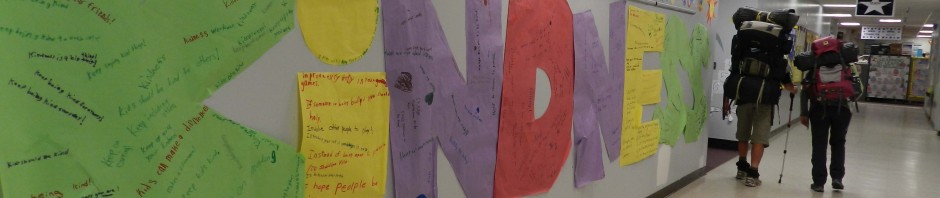
Kindness features a string ensemble to portray good deeds witnessed across America. The movement starts by conveying humanitarian issues America faces, transitions to trail angels encountered during the journey and concludes with a folk song about the many forms of community kindness. At times the instrumentals withdraw to the background as interviews from the journey relate tales of kindness.
This version of Kindness is without the vocals and lyrics that accompany the live version. Here are the lyrics:
Can kindness change the world? Yes it can. Oh yes it can. Can kindness change the world? You know it can. It can cure you of a frown, turn your life around. Can kindness change the world? Yes it can.
Can children change the world? Yes they can. Oh yes they can. Can kindness change the world? You know they can. They can show us how to care, with a breath of fresh air. Can children change the world? Yes they can.
Can a village change the world? Yes it can. Oh yes it can. Can a village change the world? You know it can. It can take care of its own, no need to be alone. Can a village change the world? Yes it can.
Can we all change the world? Yes we can. Oh yes we can. Can we all change the world? You know we can. We can feel the pain of others, treat them like our brothers. Can we all change the world? Yes we can.
You will find American Discovery – Kindness inspiring. Here it is:
Tuesday content will be set aside for culture, based on the movements of the American Discovery Symphony. Others will contribute as well, first on the Humanity Hiker Facebook Page, later on this blog when set up for that. Here is a recap of the journey, symphony and movement behind Cultural Tuesday.
When Cindy lost her job because of early cognitive decline, we resolved to reboot her life with a long distance hike along the American Discovery Trail. We walked over 5,000 miles from the Pacific coast back home to Connecticut, over a full leap year of 366 days. The journey lived up to the name of the trail we followed; we discovered America in ways few people experience.
American Discovery uses music, photos, sound effects and interviews to portray this journey across America. Five movements of Beauty, Culture, Kindness, Joy and Journey portray different themes of discovery. As the symphony unfolds an additional theme emerges: a loving couple living life fully despite a tragic illness.
Culture features an acoustic rock ensemble to portray the different rhythms of culture across America. The movement transitions through themes of railroads, agriculture, cities, small towns, rivers and rail trails with differences in tempo and melodies. Witness the grand mosaic of cultural diversity across America taking shape. Here is the orchestrated version of American Discovery – Culture.
We need ways to uplift our lives during these trying times. My symphony, American Discovery, portrays five themes of discovery that might infuse a little beauty, culture, kindness, joy and adventure into your lives, even as you stay home. Mondays will be the day for Beauty.
I recently finished what I consider to be the final draft of the first movement, American Discovery – Beauty. This final version adds two instruments to the previous version I shared, cornet and bass trombone. The music portion starts at the 1:30 mark if you want to skip the narrative.
In future weeks I will introduce the other movements. For example, next week I will start Cultural Tuesday. Only the last movement awaits full orchestration as of right now. Will it be ready in a month?
The idea eventually is to encourage you all to contribute your own photos or stories on Beautiful Monday, Cultural Tuesdays etc. Initially these contributions will be solicited on the Humanity Hiker Facebook page, as this blog is not set up for that yet. Someday it will be. That is part of my ongoing plan for my next phase of life.
We have been “social distancing” now for over three years, since the time that Cindy no longer could walk. Given her overall health and will to live, we could be social distancing even after restrictions are lifted. Just when I was running out of inspiring or informative material to share about caregiving and brain health, here comes this golden opportunity to offer my counsel as an expert couch potato.
First, a precaution. Folks, there is a downside to becoming accomplished at sitting in front of a television. In this time when the health of your immune systems becomes critical, being a couch potato can be very bad for your health. I feel like I should add a warning “don’t try this at home,” but that does not quite fit here.
As a nation this is something for which we need to be particularly mindful. The last I knew we were 43rd in the world in life expectancy. When I went to double check on that statistic I discovered I am wrong, we are 46th. When I first researched this statistic more than a decade ago, as part of researching how our social systems worked, we were 35th. An article in Lancet projects the USA to be in the sixties for life expectancy by the year 2040, based on United Nations data. We are by far the worst of any developed country, even worse than some less developed countries, and trending down.
I am not aware of world rankings for immune systems, but there is other data to suggest this is correlated to our life expectancy. Measles are ten to a hundred times more fatal in this country, depending on the dataset, than they are to someone in Japan. Not all infectious diseases are the same, but that provides a good reason and a projection that our younger population is likely to be affected more by COVID-19 than any other developed country. If our immune systems are lower, our fatality rate will be higher.
One of the major factors undermining the immune systems in this country is stress. Certainly economic stress has risen with five decades of increasing wealth disparity, but we also tend to become stressed over a number of divisive issues. This includes tackling a pandemic, or acknowledging that one exists. Other factors contributing to a weakened immune system are being sedentary and socially isolated. The potential solution to COVID-19 is also one of this country’s biggest problems.
That is why I caution, if you join me in a couch potato revelry, that you still go for nature walks if you can, the best kind of walk for your health. I also suggest you snuggle with whomever you are quarantined. Never mind if there is awkwardness or you fear the wrong message is being sent, agree that this is best for your health and put your arm around the person sitting next to you on the couch.
Our preferred social distancing activity.
Regardless of your normal preferences, choose shows more likely to release dopamine than adrenaline. Adrenaline and cortisol are our fight or flight hormones, very useful in small doses, but toxic in quantity. Dopamine and oxytocin are the hormones you want to encourage right now to boost your immune system. Go ahead, watch a chick flick! Or an inspirational story! No one needs to know.
Being a couch potato also might alleviate your stress by distracting you from the antisocial, stressful combativeness of divisive issues on “social” media. I am guilty of this as well. As I share with you my couch potato expertise, and as I prepare for an eventual new phase of life, I have ideas for changing this.
On Facebook I am starting a Couch Potato Corner geared mainly towards trivia, such as what show has won the most Emmys? Polls such as best sitcom romance will be solicited. I am working out some other activities as well. Meanwhile, this blog is not designed for social media activity and I will be fixing that. I am looking into BuddyPress as a companion to the WordPress I use. I welcome anyone with BuddyPress experience to give me some tips.
When converted, my blog will not be a social media platform, at least not like the ones that so often become antisocial platforms. Instead I aim for a social, positive and active media platform. You know, like the main ingredients for good brain health. One idea is to use the symphony I am composing about American Discovery as a starting point for people sharing the beauty, culture, kindness and joy of their own personal journeys.
In addition to this blog, I am working on a series of writings that provide a model for finding our way through the complexities of society, based on a destination of combined brain and social health. I hope to make the esoteric yet practical readable. I include approaches towards knowledge, society, freedom, addiction and wisdom that will assist on a journey towards wellness.
Why not assist me with these writings? Help me make the esoteric yet practical for wellness readable by reviewing my writings on finding our way. Just send me a message and I will provide a copy of the first essay to read. If that engages you I will send you the next one.
After all, reading is a respectable activity for a couch potato.
Last week I made a Facebook announcement for Cindy’s birthday, calling her my Expedition Woman. I am proud of Cindy, a woman who has hiked thousands of long distance miles, but that pales in comparison to the pride Cindy has in herself. An anecdote I frequently share with friends and family underscores this.
We were on a practice hike for hiking the Pacific Crest Trail with our daughter Charissa. Cindy now was diagnosed with Alzheimer’s and, though she could still hike, she needed to be assisted with everything else, including nature breaks. Unlike our previous hike of the American Discovery Trail, Cindy would not be getting better during our upcoming journey.
As we were setting up camp I made the mistake saying Charissa is the Expedition Woman now. The dirty look Cindy gave me made clear that SHE alone held that title. I never again made the mistake of calling anyone else an Expedition Woman in her presence.
After I posted the birthday wish to “my Expedition Woman” on Facebook I got to thinking about why her reputation was important to both of us? The answer lies in the experiences shared.
Experiences like hiking an unfinished trail for months, applying our map and compass skills frequently.
Experiences like camping on a snowfield above 10,000 feet in six below weather.
Experiences like hiking 25 miles in the desert with the temperature climbing as high as 130 degrees.
Experiences like many thirty plus mile days wearing 40-60 pound backpacks.
Experiences like going over two weeks in between supply stops.
Experiences like being sheltered from rainstorms, windstorms, dust storms and blizzards in our tent.
Experiences like crouching on our sleeping pad for insulation in the middle of an exposed desert as lightning strikes around us.
Experiences like the miles upon miles upon miles of conversations and games played as we distracted our minds from hiking over nondescript terrain.
Experiences like the miles upon miles upon miles of breathtaking beauty making music to our souls in harmony.
Experiences like the thrill of treacherous water crossings, hazardous snowfields and wet, rocky descents.
Experiences like the peace of forest streams, alpine lakes and brilliant sunsets.
Experiences like hiking 100 miles around one of the most beautiful mountains in the country with our three children.
Experiences like pedicab rides and adult stroller jaunts of up to ten miles no matter what my Expedition Woman’s condition is, because that is what we both need.
As I recalled all these rich memories of shared experiences I realized the delight in calling Cindy my Expedition Woman was not about pride. I call her that as a reminder of our life together.
Charissa comes to visit on most Fridays, making that a day I can go outside by myself for exercise. My usual route takes me up to the top of Lovers Lane and back, about four miles. The second mile is all uphill on a dirt road through the woods. Even if I walk the other three miles, running up this one mile gives me all the workout I need and still be back in under an hour.
This time I finished my “walk” by going to the pub to order supper for Cindy, Charissa and myself. As I waited for our meals to be prepared I sat at the bar and had a beer. First I struck up a conversation with the bartender, pointing out that moving a particular bottle on a shelf to the left would make it less likely to be knocked off. I admitted I was an obsessive kind of guy that way.
A couple at the end of the bar overheard the conversation and chimed in they were similarly obsessed, indeed had made the same observation about the bottle. In short order I was sitting next to John and Maria and they were treating me to another beer. Since I do not get out at all a second beer loosened an already fairly loose tongue.
I am adept at meeting and chatting with strangers, to the point where I am seldom strangers with anyone for long. From all my long distance journeys I have extensive practice at this, but I also have the right attitude. I believe people are social.
Early on this belief was merely part of my inherent nature. Then I engaged in social systems research and found out our “uncivilized” condition was much more social than our “civilized” condition. The social ideal of “being civilized” drips with irony. More recently I am engaged in brain health research and the same conclusion pops out: we are meant to be social, since being social makes us healthier.
We are not as social as could be because by nature we also tend to live up or down to the expectations of others. Our society is a mess in regards to how little we expect from others, particularly others of a different country, culture or demographic. What should be normal social behavior driven by empathy we praise as heroic, while antisocial behaviors proven bad for our hormones are considered normal. At the root of this cynicism are authorities that nurture our distrust of humanity because we will then place greater trust in authorities and heroes.
At one point in our conversation the topic of kindness came up. Maria shared a story about her father once asking her what was most important for a person. Maria at first responded “intelligence,” but her father countered with “kindness.” This profoundly affected her.
I have a similar question for folks as Maria’s father. If you were to form a society where everyone had one particular trait in common, what would that trait be? Many civilized folks would answer “intelligence,” or the “best and brightest,” those who best facilitate progress. I go with what our natural selves would seek as the one trait everyone in my society should have: loving. That might mean a few less civilized gadgets and comforts achieved, progress would be less revered, but to the benefit of our brain and societal health.
My order to go came out as we chatted. I told John and Maria not to worry, my daughter Charissa would readily forgive her Dad being delayed by this rare occasion, being out on the town, being social. Yet as our conversation continued Charissa eventually called to find out what was going on. I put her call on speaker phone and John charitably covered for me, speaking to Charissa as if a daughter of his friend was also his friend.
After Cindy passes away my blog and writings will continue. Perhaps I can help some folks believe, for the sake of both brain and societal health, how natural that being friends with others, even strangers, can be. …. Or let’s meet at the pub and chat.
“Are you hungry?” I asked before leaving our “bedroom” to make breakfast.
“Yes,” she replied in her barely audible manner these days.
Cindy responds to a question occasionally, though not very often. In fact, she infrequently makes any verbal sounds that would be attempts at communicating. I attempted to put Kirk Jr. in her arms before leaving, but she appeared to be resisting. I asked:
“Do you want Kirk Jr.”
“No,” she responded breathlessly.
Now this was uncharted territory. Two responses minutes apart, rather than a week apart, was cause for notice. After breakfast we did her exercise routine, then I balanced Cindy on her feet to “dance.” She clutches her arms to her chest as always in her initial stance. I need to pry them loose and wrap them behind my back for the sake of our “dance.”
“Let’s get this arm around me where it belongs,” I say, as I often do:
“Uh-huh,” she responds for the third time in the same morning. Cindy also giggled and smiled frequently during the morning, almost like the “old” days (a few years ago) when I could get Cindy to smile simply by smiling at her first. Now this was something worth writing a blog post about.
Now for the bad news. Cindy’s lucidity came the second morning after she had another seizure, even though I gave her anti-seizure medicine right before the 2:30 am episode. No subsequent seizure has been as bad as the first, but this one was up there. She bit her tongue, causing blood to trickle out of her mouth, the second time in a row that has happened from her seizures.
I do not think Cindy is near death, but there is a phenomena called paradoxical lucidity that occurs to some people who do. The week or so before they pass away their cognition becomes much clearer. Could there be some relationship between a seizure assaulting the mind and the clarity that sometimes occurs before death?
Cindy has experienced about ten seizures since the first one last March. After each one Cindy was most likely to respond to a question; most likely to show recognition of people; most likely to smile brightly. This observation comes with no definitive insight, but there must be more than coincidence to this.
A partial explanation could be the supplements I give Cindy to mitigate general twitching and occasional seizures. At least I can claim that no seizure has been as bad as the first one nine months ago. I do not claim that these, nor any supplements automatically enhances brain health, for reasons I will cover in a subsequent post. However, the mechanism of action for the supplements I use are certain and the results may be more than coincidence. Considering that none of them have harmful side effects, others might give them consideration.
I give melatonin as a noted brain hormone. People usually take melatonin to help with sleep, but it has known anti-seizure properties and facilitates removal of brain toxins as well. I give ashwagandha, an herb also with anti-seizure properties and proven to lower blood pressure. Admittedly, I am the one in need of lowered blood pressure, but lower blood pressure also means better flow to the brain.
I give Cindy a choline supplement, more for brain enhancement than an anti-seizure measure. Most Alzheimer’s medicines to date are anticholinase inhibitors. That is a fancy way of saying they allow choline to be processed by the brain more effectively. I do not propose with any certainty that a choline supplement will reverse or slow down dementia, but as an essential nutrient for the brain I figured it does not hurt.
Other supplements I give Cindy are Vitamins C and D, though these are more for general health. Three years ago Cindy could no longer walk; nine months ago she became fully incapacitated an placed on hospice care. Yet here she is, still enjoying life to the extent that she can. I share may approach with supplements not as a proposed cure but as possibly enhancing the quality of life during this tragic affliction.
Rather than New Year’s Resolutions I believe in New Year’s Directions.
A new direction for me this year is the lack of direction in Cindy’s decline. For the start of the past few years I was uncertain whether Cindy would still be around for the next. Yet here she is, now on hospice care, not much worse than when hospice started last March. She has lived four months longer than the default time frame for hospice care, with no further decline in sight. That leads me to now look at her condition more like indefinite permanence rather than unrelenting decline towards an end.
This new direction for Cindy’s condition means new directions for me as a caregiver. In past years I would not incorporate some activities into a routine because of the uncertainty of continual decline. I am ready to change that for my New Year’s Directions, using my favorite brain health mantra of “Be Social. Be Positive. Be Active” as a guide. I also make these directions public, as I welcome anyone to assist with these new directions.
This new year I want to take advantage of our adult stroller for small gatherings around our dining room table, sharing meals, light-hearted games or conversation. The stroller fully supports Cindy when she sits, expanding what we can do. We recently attended our first Christmas Eve service in a few years, thanks to the stroller.
Earlier in her decline, Cindy used to enjoy watching people have a good time together; I believe she still can soak in some of those vibes. We have many communities to approach: family, neighbors, hikers, nurses, etc. This new direction improves my social life as well.
Greater positivity in the new year will require less time spent on traditional social media. Software exists to turn one’s blog into their own social media platform akin to Facebook. This Humanity Hiker blog started with the tagline: “Love kindness. Build community. Believe in humanity.” Lately from my brain health research I have adopted the motto: “Be social. Be positive. Be active.” Over the year I will take steps in the direction of providing a social media platform guided by both my tagline and motto, a platform with positive, affirming interactions between members.
Another direction I will continue to follow for being active composing the American Discovery Symphony and creating the accompanying slideshow. Last year I orchestrated first drafts for the first four movements of the symphony. This year I will orchestrate the “grand finale” movement and continually take steps towards turning all the drafts into a final, polished project. I feel confident that the American Discovery Symphony will provide a touching tribute to Cindy, an inspiring call to discover America, and even a little insight on brain health.
Care to assist me? If you are in the area, let us have a game night. If you are tired of the negativity on traditional social media platforms let me know and I will keep you in the loop about mine. If you want a preview of any part of the American Discovery symphony drop on by, or maybe I can arrange for a small “gig” at your place.
There is another new direction for this year. Our daughter Charissa is due for our first grandchild in July.
Those are my directions this new year to be social, positive and active. What are yours?
Towards the end of my first thru-hike I encountered a coal-miner, also nearing the end of his thru-hike. We took a break and chatted awhile, as back in the seventies thru-hikers encountered each other much less than they do now. He confided he had black lung disease and had expected he would pass away during the thru-hike, before reaching the northern terminus of the Appalachian Trail. Now that Mt. Katahdin loomed imminently before both of us I asked the obvious question of what he would do once he finished. His reply:
“Keep on goin’ I s’pose.”
Coal miners once used canaries as carbon monoxide detectors. Their rapid breathing and heart rates provided an advance warning when conditions in the mine became life-threatening. Us caregivers can benefit from our own “canary in a coal mine.
My previous post about having constant dreams about hiking, along with an occasional dream about Cindy, prompted a few comments of concern or support. One of them was apprehensive that I should be looking into a professional caregiver and begin the letting go process. Please know that my own “canary” does not yet indicate an unhealthy situation. Blood pressure is my indicator.
I have a family history of hypertension, plus my situation is conducive to stress. Vascular dementia results from poor blood flow, which correlates with blood pressure. To address this concern I acquired a blood pressure monitor and made lifestyle changes to keep my blood pressure down. I could take pills instead, but there is a greater benefit from using lifestyle factors. If I keep blood pressure down artificially by pills then that no longer serves as an indicator that my situation is unhealthy. I mitigate the immediate threat of hypertension, but not the overall threat of an unhealthy situation, while introducing an element of risk not associated with lifestyle factors.
One of the important lifestyle factors for both blood pressure and brain health is the deep sleep that allows the brain to eliminate toxins. Though some dreams can occur during deep sleep, they mostly occur during the REM stage, particularly the dreams one remembers. C. S. Lewis in his Narnian fantasy was onto something.
Excessive dreaming indicates you are not getting enough deep sleep. The excessive dreaming that prompted my last post did indeed correspond to a rise in my blood pressure. Fortunately, I have managed my routine to obtain a healthy blood pressure range again and the dreaming has decreased a little as well.
Admittedly, keeping blood pressure down with lifestyle factors is not easy, yet lifestyle factors are as effective as pills. In the past I have been able to reduce blood pressure from an all time high of 172/123 down to 120/78, in a little over a month. My problem is keeping blood pressure down without relapse, like dieting this can be difficult (the two are related, of course). A regular routine with taking pills is much easier to maintain.
Yet keeping my blood pressure down with lifestyle factors I must (and speaking like Yoda I do), because I do so for two people. No one can take better care of Cindy than me if I stay healthy, but only if I stay healthy. Only through the pursuit and success of lifestyle factors will I know that is happening. Once again, lifestyle factors are as effective than pills, certainly are healthier, as long as one perseveres. I am perseverent; I just need to keep up with everything in the necessary routine. For those who have expressed concern, if eventually I cannot succeed at managing blood pressure naturally I will start the process of “letting go.”
To each their own as family history and situation dictates, but I suspect blood pressure would work well for many caregivers as their “canary.” However, the goal for effective caregivers should not be knowing when to escape, but to know which, when and how conditions and routines must be changed to make escape unnecessary. Escaping from an unhealthy coal mine is one thing; an escape that risks the health of another when you are the best person for the job is another.
One can imagine why the coal miner chose the Appalachian Trail for his final journey. Cooped up in the dust filled mine that plagued his lungs for most of his life, he no doubt desired to spend his remaining days in the open air. Who of us can even imagine such a craving? We can understand as well why he was so nonchalant about reaching Katahdin. The Appalachian Trail was not a bucket list item to cross off; he just wanted to keep tasting fresh air.
In the coal miner’s incidental wisdom lies the key to success for all long journeys. I have hiked thousands of miles with many long distance hikers; I have met a great many more. Not a single one of us dwells on the destination, that would be overwhelming. Besides, the success of a journey really lies in the journey. So does the true motivation. The destination merely signals, like the “canary in the coal mine,” when one needs to “let go” of one journey and begin a different one. Until my own “canary” signals otherwise this caregiver will “Keep on goin’ I s’pose.”