On Tuesday evening, May 24, 8:00 pm, the American Discovery Symphony will premiere with a full orchestra at the Music Shed, on the Yale Summer School of Music campus in Norfolk, Connecticut. The symphony synchronizes five movements of music with photos, interviews and sound effects from our 5,000 mile walk across the country along the American Discovery Trail. In the telling of this story the symphony presents both a travelogue and a love story to the audience. Free General Admission tickets have been limited to about half capacity and are available here:
The ADT Journey – Week 47
The C&O Canal started in the mid-nineteenth century as a towpath along the Potomac River, using a series of 74 locks to shepherd boats over difficult stretches. Now a trail shepherds hikers and bicyclists over the same route, through a National Historical Park that features the locks and other historical structures. Civil War signage at a few spots educates the recreationist along the way.
Frequent campsites with toilets and water made camping as easy as the gentle grade of the trail. The height of spring greeted us along this particular stretch, with frequent photo opportunities for birds, flowers and butterflies. As an added treat we hiked through the longest of all tunnels along the ADT, the 3,118 foot long Paw Paw Tunnel.
My blog posts from ten years ago revealed we took a rest day in the trail town of Hancock, but I have no photos taken of that day. I know we stayed at the United Methodist Church, where I caught up with the Internet and chatted with the staff, but I neither gave a talk nor interviewed anyone. Ky returning to us again after her longest time away was the one thing memorable about Hancock.
After Hancock the traffic along the C&O canal picked up. Most were bicyclists, which made us stand out as targets for conversation. Kathy stopped to give us snacks. Tom & Dave delighted in telling us about their fishing trip. We discussed humanitarian issues with Morey and his dog, though the dog was not interested. We got tips from the two brothers and lawyers, Eric and Jack, about our upcoming meeting in Washington, DC with our Congress representative.
I set up the meeting in Washington after my talk to the Lions Club in Dodge City, Kansas. In response to my information about declining community involvement, some of the members declared: “You need to tell them fellas in Washington.” As that meeting drew near I spent many a mile thinking over what information needed to be conveyed.
A six mile detour took us away from the bike trail and by the house of Sam and Dana Wright. Sam hailed us to chat as we were walking by, subsequently inviting us inside for water, snacks and meeting the family. Dana was a judge who through the court system witnessed the problems of housing and hunger our mission advocated addressing through community involvement. I took mental notes to work this into the conversation with my Congress representative.
Ky picked us up for a speaking engagement at the Christian Community Church of St. Paul’s, seven miles south of Harpers Ferry, West Virginia, at the request of Pastor Roland England. Four former denominations merged together to form the UCC: Reformed, Evangelical, Christian and Congregational. Pastor Roland’s church joined the UCC as a grassroots, community church. They purchased a defunct Lutheran Church for one dollar, while start up money from the UCC enabled them to build from there.
Every Sunday morning at 8:30 am Roland, his wife Nancy and parishioner Shawn gather to cook pancakes, bacon, eggs, home fries and scrabble. A handful of parishioners come every Sunday morning at 9:30 to eat and a handful more join in for the service at 10:00.
The church service was the most informal I encountered, with everybody including the pastor dressed in jeans and flannels. I believe technically I gave a lay sermon, but felt more like a talk I would give at a school or Lions Club. As was often the case, questions I received were more about hiking than kindness and community. I was asked the two most common questions, one being about how many shoes were worn out, the other being about bears.
I gave my standard answer about bears, they are nothing to worry about in the wilderness if you know what you are doing. I even had the recent bear encounter in Dolly Sods to use as an example. One parishioner asked if I carried a gun. I reiterated that no, instead I knew what I was doing. He somewhat dismissed my answer and claimed that we ought to be carrying guns to protect us from bears and other dangers, pitting his handful of wilderness miles against my 20,000+ miles.
I agree wholeheartedly with the NRA slogan that “Guns don’t kill people; people kill people.” Unfortunately, prior to the seventies people cited hunting as their number one reason for owning guns, now they cite protection. This shift occurred even as crime rates went down; occurred because the NRA and their sponsored politicians scared the bejeebers out of the public for the sake of gun sales. Unfortunately, an apprehensive and at times angry person near a trigger is more dangerous than a calm person. Our journey across the country, from Green Mountain Falls, CO to Harpers Ferry, WV, provided testimony as to the growing apprehensions of gun owners, fueled by NRA rhetoric prioritizing gun corporations over members … or lives.
Harpers Ferry lies at the crossroads of the ADT and Appalachian Trail, with the headquarters of the Appalachian Trail Conservancy located there. As a former AT thru-hiker I stopped in at headquarters to see how they were getting along without the famous Jean Cashen, former ATC secretary and friend to hundreds of AT hikers. The new folks, Dave and Wendell, greeted me with the same enthusiasm. Prior to this year they kept a photo album of long distance hikers that contained only AT hikers. This year we became the second pair of ADT hikers added to that photo album, “Boston” and “Cubby” having been the first.
While at ATC Headquarters we met Cassie Meador and Matt Mahaney, who were hiking 500 miles along the AT and collecting 500 stories about community, energy and dance. Cassie’s background in dance led to a friendship with Heather Doyle, also a dancer who happens to be the daughter of Warren Doyle, arguably the most recognized name among AT hikers and the person who organized the Appalachian Trail thru-hike in 1980 that brought Cindy and me together. With similar missions in mind, Cassie and I interviewed each other about our different community experiences.
We continued to encounter steady traffic on the C&O Canal after Harpers Ferry. We met thru-hiker Renaud, heading in our direction where the American Discovery and Appalachian Trails overlapped, who told us about the kindness he experienced as a cyclist from Belgium to Jerusalem. Then we met cyclist Tom, who told us about the kindness received in every book about thru-hikers he read. While we chatted with Tom, Phil stopped by while on bike patrol, relating to us that he was involved in the wounded warrior project and alleviating southern poverty.
We met Phil Wilkes at a campground the same day we visited ATC Headquarters. We mentioned to Dave and Wendell that we were the first ADT thru-hikers to continuously hike from west to east. Dave added: “that people know about.” I protested that, unlike the AT, very few people hiked the ADT and easily fell in the radar of folks like Sharon Weekly, Marcia Powers and Dick Bratton. Then meeting Phil caused me to rethink that boast.
Phil had recently lost his job and was down to no resources and no prospects, prompting him to hike the ADT until he either figured out what to do with his life or there was no more trail to hike. He was only vaguely aware of the ADT resources out there and I knew for a fact that, as of the day we met, none of the usual ADT “scouts” knew about him. He could have, in theory, hiked the entire ADT without anyone knowing … or he could have figured out what to do with his life, which is often a result of long distance hiking.
By the way, the answer to the shoe question was 8 pairs for me, only 3 pairs for Cindy. I pronate, while Cindy has one of the most beautiful, efficient strides I have ever seen.

Posted in American Discovery Symphony, American Discovery Trail, Brain Health Needs, Building Community, Humanitarian Issues, Lasting Love
Comments Off on The ADT Journey – Week 47
The ADT Journey – Week 46
Before parting from Gwen we treated her to breakfast at the Breakfast Nook, a special restaurant that helps young adults with previous dependency troubles become independent through work and mentoring. We chatted with mentors Keith Bishop and Tammy Robbins about the success of their approach and Gwen left intending to establish a connection between them and her college, Fairmont State.
After breakfast we hiked through the Canaan Valley National Wildlife Refuge and up into the Dolly Sods wilderness. Unfortunately, the higher elevation meant leaving blossoming spring behind, experiencing mainly late winter vegetation with a few spring buds. At least we hiked on well graded and easy to follow trail, unlike some of our wilderness experiences west of the Rockies.

We encountered no other people in Dolly Sods, only a few bears that charged off once they spotted us. Bears in the wilderness avoid hikers, unless you are carrying food that is easy to smell. We package our food well, with our long distance, sweat soaked packs providing an extra deterrent.
Another potential problem with bears is getting between them and their cubs. I once spotted a black bear up ahead on the trail and stopped to take pictures. While I clicked away the bear got off the trail and headed in my direction. Once parallel with me on the trail, about 12 feet away, I noticed the two cubs up in a tree behind her. At that point the bear moved directly towards me and I responded by raising my arms and yelling at her. She stopped, apparently mulling over whether she should bother with a crazy person, and I headed on up the trail.
A touch of nostalgia hit as we knew Dolly Sods would be our last immersion into wilderness along the ADT. We stopped several times just to soak in the panoramic splendor. I fancied that Dolly Sods would be a fitting end to such a long journey, similar to finishing the Appalachian Trail on top of Mt. Katahdin. Yet I knew by now that fulfillment lies in the journey, not the destination. As the ADT continued beyond Dolly Sods, now mostly downhill to the Atlantic, so would the fulfillment of our journey.
Had our journey ended at Dolly Sods, we would have missed the next day of kindness coming out of that wilderness. Pastor Mike Humphrey spotted us walking by his home and invited us in for refreshments. He had hosted Jerry and Karen two years prior, ADT hikers whose names popped up repeatedly during our journey. He lamented not being able to host us (though I am not sure we would have ended our day that early), as his family was packing for a vacation even as they offered us snacks.
Mike called two of his parishioners who lived farther along our route to host us that evening. Thus towards the end of that day we found Leonard and Jeannie Carr doing yard work while keeping an eye out for us to arrive. We tented in their yard but went inside to join our hosts with supper, breakfast and, most importantly, kitchen table type conversation.
We followed surprisingly scenic Knobley Road north towards Maryland, at times along scenic streams, at times with landscape panoramas, always with the blossoming of spring in evidence. Small churches, quaint cemeteries, imaginative mailboxes, rustic barns and rural farmland once again dotted our route, as they did in Ohio. Ranches out west and agribusinesses across the heartland tend to be large, the rural parts of the east contrast starkly with decentralized and diverse agricultural endeavors, such as the Amish.
We occasionally met and chatted with people along Knobley Road, discovering from a chat with Don and Adam that impending school centralization threatened the rural local charm of the area. This was a phenomenon I studied in graduate school, based mainly on the research of Jonathan Scherr. Scherr found that the centralization of schools often increased education costs, contrary to what advocates have turned into conventional research. My own subsequent research uncovered that since school centralization first took off in the fifties and sixties the per student cost of education rose significantly over the ensuing decades.
The concern of Don and Adam was about community rather than costs. The local school is a hub of local activity bringing people in the community together. Taking away these local hubs, whether they are schools or post offices, reduces the amount of community interaction.
Another interesting conversation occurred with Roger and his son. They believed that humans were not nice, even as they went out of their way to chat with us, give us snacks and fill up our water bottles. This seemed to be a regional problem. People in the heartland prided themselves on community and kindness, even objecting slightly at the suggestion that another state may be just as kind. The farther east we traveled the more cynical people became of human nature, even while exhibiting their innate kindness.
Our last day in West Virginia occurred on Easter and much happened to make the day memorable. The evening before we wondered where to guerilla camp when a car with TJ Quesenberry and friends pulled over to ask what we were doing. TJ suggested we stay at her place, which was right along our route and just outside of Fort Ashby. Upon our arrival TJ and boyfriend Josh prepared some huge burgers with all the fixings for us. She also prepared us Easter breakfast the next morning. As if that was not enough she called her sister in Annapolis and arranged for us to stay with her as well when we got there.
We arrived early for the Easter service at the church. I once again got the opportunity to sing with the choir and once again choir members jokingly offered me a job if I stayed and continued singing with them. When I once again passed up the offer they gave us unsolicited donations.
As we neared the border we passed a family celebrating Easter with a picnic and egg hunt. We called out Happy Easter to them. Moments later two kids chased after us to give us some of their Easter candy. Once again this simple act of spontaneous kindness moved us more than the grander gestures experienced throughout the journey.
Gwen came out to meet us one last time at the border, before we left her state. She brought us gear we had stowed at her place while Ky was away. I first met Gwen as one of my Resident Assistants at a college dormitory where I was the Hall Director. She always remained one of the easiest persons for me to talk to, but I noticed now how at ease Cindy felt around her as well. Looking back now I am saddened to realize that was the last time Cindy spent with Gwen.
Once we crossed into Maryland we hiked east on the C&O towpath, now turned into a biking/hiking trail. For the first two days we encountered only three people; apparently trail users from the populated eastern portion of Maryland seldom come this far out west. We expected not to encounter people in Dolly Sods, but not encountering them on a bike trail in the height of spring gave the feel of a ghost town, or ghost trail if you will. The solitude of a wilderness area? Heavenly. The same solitude on a bike trail? Spooky. Thankfully, that changed once we reached Hancock.
Posted in American Discovery Trail, Brain Health Needs, Building Community, Lasting Love
Tagged Alzheimer's Love Story, American Discovery Trail, Live Fully, Trail Magic
Comments Off on The ADT Journey – Week 46
The ADT Journey – Week 45
From Grafton we went to stay with Gwen Jones, a close friend from our long distance hiking days, and her husband Ted McMahon. Though she lived in Connecticut when we met and hiked with Gwen, she had since moved to West Virginia where her family roots lie. They lived in Morgantown while Gwen was a professor at Fairmont State University in Fairmont.
Gwen laments the days of her grandfather in West Virginia when coal miners knew “which side they were on,” unlike today when interest groups, corporate news and political parties persuade the West Virginia public into supporting policies not in their best interest. One particular “news” culprit is the same one we encountered in the heartland riling up viewers about the campaign donations of organized labor, though minuscule in size to the donations of corporations to both campaigns and lobbyists.
Our experiences in Ohio and West Virginia suggest fracking to be the new coal. Extracting resources does not have to lead to a bust economy if enough diverse opportunities for employment exist independently of the extraction industry. Some coal towns have achieved such diversity. Yet in an age where corporate funding of interest groups and media ignores the downside of “get rich quick” industries, I suspect busts from fracking are inevitable.
While we stayed with Gwen we also met Gary Auerbach, who found out about us from the TV coverage we received in Clarksburg station WBOY 12. He lived near the North Bend Rail Trail and contacted us to stay with him, but we had finished hiking on the NBRT by the time we received his email. We invited him instead to come meet us while we stayed with Gwen.
Since Gwen was a professor at Fairmont State University, we arranged to meet Gary at McAteers, her favorite lunch spot in Fairmont. Gary incorporated his skills as a juggler, dancer and world frisbee champion to become a “playcologist” that traveled to schools around the country encouraging kids to get outside and play more. Gwen brought along her coworker Matt to the lunch, seeking tips from Gary for the ultimate frisbee program at FSU the two of them led.
After our lunch meeting I gave a talk to Fairmont’s outdoor adventure program that Matt directed. Later I gave a talk to an honors leadership class that was finishing a film on Machiavelli when I arrived. By this time I felt so comfortable with my kindness and community material that I could incorporate the material on the fly into a discussion about Machiavelli. These would be my last college presentations of the journey, which precisely mirrored the first ones I gave at Colorado Mesa University in Grand Junction.
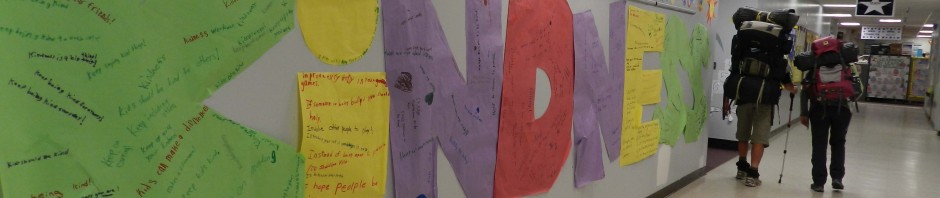
Gary arranged for us to speak as well, at Watson Elementary School, where his wife Wendy worked as a school counselor. At the time the school was doing a unit on kindness and as we entered the school corridor, KINDNESS was posted in big letters on the wall. I had no trouble adapting my material for this audience.

While staying with Gwen we made a trip into downtown Morgantown, where third graders from St. Francis Elementary School were leading a “Lend a Leg” protest, raising awareness about the children maimed and killed all over the world due to landmines and cluster munitions. The children paraded with “Lend a Leg” signs on one block of the street and had a station where passersby got a picture of their leg taken in exchange for their donation.
As we left Gwen to resume hiking on the trail, Ky left to go back home to keep her dog company in his final days with cancer. This would be the fifth time Ky parted from us for a few days, but this parting differed from the rest. All the other times Ky needed a break from the journey, this time you could tell she hated leaving us. We were sad to lose her for a while as well.
Yet as with every time we hiked without support, kindness tracked us down. On our way from Grafton to Parsons, WV, motorists stopped to chat with us, then sent us to the Tygart Lake Public Golf Course near our route. We stopped and asked to use their restrooms. The managers gave us Cokes and two golf caps to take with us.
The day before Parsons we were nearing the campground where we would stay that night when a young man with guitar slung around his shoulder game out to greet us from his porch. His mother Anita, father Mike and neighborhood friend Kendall then came out to join Tim in chatting with us. Tim and Anita had life threatening experiences that made them grateful to be alive and inclined to be kind to strangers. When we reached the campground later, Mike came by with hot dogs, bread and bottled water for us.
We arrived at Parsons on Palm Sunday, just in time to attend the St. Johns United Methodist Church service, along with attending their pizza lunch and Easter egg hunt afterwards. I asked Pastor Phil Dent if we could stay in the building that evening. After he said yes we went out to get more supplies for the next stretch. By the time we came back he arranged for us to stay at the Parsons Country Inn, Ken Bott proprietor, with supper and breakfast included. I donated some of the food I just bought to the church and packed the rest. Before transferring the the Parsons Country Inn I sang in the choir for the evening Palm Sunday service and we attended
Ken had a ministry of using his business to help the homeless; I guess we qualified. I interviewed Ken about his ministry and had a discussion with both Ken and Phil about community involvement. I long had known that a problem for denominational churches with engaging youth is how set they are with certain behaviors and traditions. Ken and Phil provided examples of how this problem applies to communities as well, also explaining why volunteerism has gone up as societal problems plague us, but community involvement has gone down. Young adults want to bring their own new solutions to problems, rather than be plugged into existing solutions.
The next two days out of Parsons featured spectacular beauty. A new bike trail from near Parsons to Thomas had been created along the Blackwater River. We hiked on this bike path rather than the official ADT route,along roads, as we had every confidence this would soon become the official route. We spent almost the entire first day out of Parsons hiking along a roaring river, boisterous cascades and thundering waterfalls, witnessing the blossoming of spring through the flowers and trees. That evening we camped near a small but loud waterfall that provided better soothing respite than a grand chorus of spring peepers.
The next day we reached the end of the bike trail and beyond the maps I carried. Fortunately, we soon came upon a road construction crew that provided us directions to Blackwater Falls State Park. Since the construction turned out to be in the direction our initial guide, Ed, radioed ahead to his colleagues, who waved, cheered and gave us further directions, whether needed or not.
Once in the State Park we took a side trail for the obligatory viewing of Blackwater Falls, then hiked on trails, once again on the official ADT route, towards our destination for the night, Canaan Valley State Park Lodge. Gwen booked us a room for all three of us to spend the night; she met us on the trail and hiked the last few miles towards the Lodge.
The three of us watched the UConn women’s basketball team lose to rival Notre Dame that evening. Yet not even our favorite team losing in a tournament dampened the warmth of one last night spent with our Gwen. Making new close friends all across the country was one of the best parts about the trip, but still bittersweet when there is no guarantee to ever meet again. There was no such bitterness to the sweetness of spending time with our long term hiking buddy who we likely would see again.
Posted in American Discovery Trail, Brain Health Needs, Building Community, Humanitarian Issues, Lasting Love
Tagged American Discovery Trail, Build Community, Humanitarian Issues, Live Fully, Trail Magic
Comments Off on The ADT Journey – Week 45
The ADT Journey – Week 44
Most hikers I suspect would view the North Bend Rail Trail as tied with the C&O Canal Path for the best hiking along the entire ADT route, edging both the Katy Trail and the American River Trail because of their paved surfaces. I am not most hikers, I actually relish steep climbs, but I have to admit that the unimproved trail surface, easy grade, easy camping (once I figured out to avoid spring peepers) and the welcoming sunshine and buds of spring made for a blissful experience along the NBRT.
The tunnels topped off the experience for me. In between tunnels I entertained myself by thinking about what I would say in my next narration. Themes of railroads, kindness, animals and water experienced during our journey would end up in the movements for the symphonic journal I later created. Two of the tunnels were about a third of a mile, requiring a good five minutes of getting through them with flashlight in hand. Many greeted us with a small waterfall near the entrance, still cascading after the fierce storms we were able to avoid in Parkersburg, as well as being wet inside.
The trail brought us by quaint trail towns, converted from being former rail towns. A mural in a Pennsboro cafe highlighted the embrace of this conversion by local proprietors. I recall again the hassle Ky received from angry landowners when she ventured onto what would be a future rail trail in Kansas, and how formerly angry landowners became enthusiastic supporters of the Katy Trail in nearby Missouri, once the economic benefits from tourism became clear. Such benefits are modest but sustainable. Rail trails do not bring a boondoggle from extracting resources, but neither do they cause a bust. How and why do the influencers of American society lead us to think that a growth boondoggle is better than economic diversity, community resiliency and small proprietor sustainability?
A reporter came out to Pennsboro to do a story on us, the first one since Indiana. Looking back I am not sure why we did not have or apparently pursue publicity in Ohio, not even in Cincinnati. My working theory is we were so glad to be trail hiking and camping again that I put publicity out of mind. Readers of this account may find this ironic, or even doubtful, but by nature I am not a publicity hound, or at least publicity is only a means for me, never an end. When Cindy’s cognitive decline suggested I needed to find different means of earning income in my middle ages, the research I did all came back to the need for publicity as a means. I applied this lesson learned to validating our public mission for kindness and community.
West Union stood out as the largest town along the NBRT. Here we met up with Sharon and Paul Weekley. Even though they were members of the West Union Lions Club and should have been on my radar before our journey started, ironically Sharon contacted me instead and kept in touch since California. Sharon first became interested in ADT hikers in 2006, when she met the mother and daughter team, Patty and Robin. After hosting them she became involved with the ADT and searched the Internet for people aiming to start hiking the trail. Once she became convinced they were legitimate she reached out to them, as she did with us.
Sharon arranged for me to speak at both the West Union Lions Club and Doddridge County elementary school. In either case I now drew heavily from my experiences during the journey. For a Lions Club I emphasize the lesson to “confuse who is giving and who is receiving” when building community. For an elementary school I highlight the compassion and initiative of ten year old Ethan Roos for helping the homeless.
Our stay with the Weekleys was an “one of the family” experience. I believe Ky got to spend even more time with them apart from us. Sharon now has become the West Virginia Coordinator for the ADT, and additionally manages their public Facebook page. So if you are reading this now Sharon, thanks once again!
Ky slackpacked us from West Union to Clarksburg, where the NBRT ended. With spring in session we encountered increasing numbers of people in the small rail trail towns we passed through, including one person wearing a Monkees Tshirt. I could not get the song “Last Train to Clarksville(burg)” out of my head after that.
We stayed at the Calvary UMC in Clarksburg, where Pastor Rod Heckert paid us a visit the evening of our arrival. He asked how we managed to take a year off to tackle this journey. I confessed we left careers behind (though I still was not making public that Cindy was forced to leave because of her cognitive decline) and were not sure where our income would come from when we returned. I do not know if this was his intent all along, but Pastor Rod used our situation to underscore his sermon the following morning about “Leaps of Faith.” He called us up to the altar for “show and tell,” but otherwise I did not have a speaking engagement at the Calvary UMC.
We left Clarksburg full packing, but at first made little progress. Our route went near Clarksburg NBC Station WBOY and I decided to just drop in to offer them an interview. To my mild surprise they ran with our story. Shortly after that we were hiking along Main Street when a man pulled over in this truck and offered us salami and cheese. About a mile later we stopped at Rollins Market to use their bathroom; before we left owner JoEllen, former owner Joe and employee Joanna made us bulky sandwiches from their deli to take with us.
The Life Hope Outreach Center was next door to Rollins Market; given our public mission this seemed like a must stop. The Center ran a thrift store, using the income to in turn fund a food pantry. In this manner they were wholly independent of any funding strings attached, which suited them just fine.
We spoke to Angela at the Center, while a teenager with high functioning autism named Billy also was there. Billy collected ties that he intended to weave into a fundraising quilt for the center. By the time we were there he had collected 2,216 ties.
We started heading out of Clarksburg around 1:30 pm, having only hiked about three miles. I had to come up with a Plan B regarding where we might stay that evening. Towards that end we stopped at Benedum’s visitor center in Bridgeport. The director of the center tried hard to scout out a potential camping spot ahead on our route and was extremely apologetic not to succeed. Instead, he put a blurb about our journey and mission on the visitor center’s web site.
Still at a loss for where we might camp that evening, we were taking a break on the lawn of a Baptist Church, which had a sign advising: “Today, give yourself in God’s hands.” This suggested an obvious parallel to the beginning of our day, when we became show and tell for Pastor Rod’s “Leaps of Faith.” When we resumed hiking I had no worries about camping that evening.
Nor should I have had. Apparently, Dave Alonso passed us while we were hiking soon after that and waited at the gate to his property for us to come by. He actually was getting the property ready to sell, but offered his gazebo for us to spend the night. He then brought us with him to pick up his wife Rosalyn and we headed back into Clarksburg for supper at McDonald’s. Rosalyn wrote columns for five different papers and asked if she could write one about us. After going publicity free through an entire state we received publicity three times in one day, through print, broadcast and web media.

The next day we hiked into Grafton, where our good friend and hiker Gwen Jones met us. Listening back at a podcast I created about our eventful day hiking out of Clarksburg, I mentioned we would see our friend Gwen, though the rhyming of those two words together twisted my tongue and after a few attempts Cindy could be heard laughing and making comments in the background. I knew at the time, while we were hiking, that Cindy improved during the journey, but going over some of the documented evidence provides even more certainty now.
The ADT Journey – Week 43
We stayed in one more UMC church in Ohio when we reached Chesterfield. Ky as usual made the arrangement with the church, though I had made contact with Lions Stan and Nancy Starling previously. Unfortunately, we arrived too late to speak to the Lions Club that evening, but I did get to interview Stan and Nancy regarding the community projects of the Chesterfield Lions Club. They also brought us breakfast food for the following morning
The main reason we arrived in Chesterfield later than planned was Rick Webb hailing us as we were hiking by his home. We stopped to chat and he brought out soda and candy for us as we listened to him talk about his family. Rick raised four grandkids, part of the demographic that we learned back in Pueblo was becoming increasingly food challenged. He showed us pictures and was proud of them all. He also was proud of his chickens and had them well trained to do “tricks” for us.
He gave me a watch that was one of three his grandsons brought him from Korea. I really did not want the watch, but knew this was one of those times when the kind thing for me to do was to accept. He also wanted to give us supper and stay the night, but our arrangement to stay at the UMC church in Chesterfield called to us.
On the way into Chesterfield we knew we had entered Amish country. I tried not to be too obnoxious taking pictures, having heard that the Amish do not like to be photographed, but I could not resist a few inconspicuous shots. At least no police officers made me erase the photos afterwards, as they did amongst the Monsanto factories south of East St. Louis.
We left the Buckeye Trail behind as we moved on from Chesterfield, yet we had no problem following the route as ADT emblems popped up on telephone poles and other structures frequently. We eventually found out why when we encountered Tim Cowan at Veto Lake Wildlife Area. He lived with his father across the street and came running down to take our picture. When he said “you look like ADT hikers,” we knew he must have something to do with the trail.
Before long we were sipping lemonade with Tim and his father Marvin on their porch. Tim brought out a briefcase with an ADT emblem on it and pulled out artistic sketches he made of the insignia, along with a postcard he received from previous ADT hikers, Dead Man Walking and Love Bug. Like Rick Webb, Tim kept wanting to do things for us, like giving us a Tshirt with the ADT emblem. Unlike the Korean watch, we were ecstatic to receive this present. The ADT still receives sparse thru-hiker traffic on it, only a handful each year, otherwise I have no doubt Tim would become as legendary as Sam Waddle or Bonnie Shipe were for Appalachian Trail thru-hikers.
Both the AT and the Pacific Crest Trail have changed since back in those days. As thru-hiker traffic increased so did the trail angels, but often the same trail angels extending trail magic to a large number of hikers. I got a little taste of this change even back when I thru-hiked the AT a third time in 1983, even more so when I returned to the PCT in 2014. The trail magic is just not the same as meeting a Rick Webb, with less intimacy and uniqueness attached to the meeting. Sometimes, trail angels have become fed up from what has become thru-hiker entitlement and stopped. Sometimes, the trail grapevine suggests that a donation be left with these often visited trail angels, in which case they effectively become hostels. Fortunately, the minimal ADT traffic avoids these problems.
Two motorists stopped to ask if we needed anything, also knowing from looking at us that we were ADT hikers. How ironic then that we spent our one night in between Chesterfield and Parkersburg, WV with a couple who had no idea their property was right on the ADT route, even though an ADT emblem was visible from their home.
Jim Polito was out planting berries for his Redbud Berry Farm when his dogs started barking at us. He hailed us and invited us to stop for a break. He finished planting his berries and we accompanied him up his driveway, where we met his puzzled wife Paula. Since we had no arranged destination, unlike the past few days, a break turned into an overnight stay in their furnished outbuilding.
We had supper and breakfast with the Politos and long conversations throughout. Jim was a chemical engineer by trade but purchased and started the berry farm as his retirement job. Paula and I discovered we might be related, with the Nantucket Coffins in both our heritage. By the time we left we felt like neighbors. They wished we could stay another night, as did we, but the journey beckoned us onward. Stopping short at their place already meant a 25 mile day into Parkersburg for our next arranged stay, our longest day with full packs since coming down the Shelf Road in Colorado.
With the advantage of hindsight, something of great importance happened as I was trying to fall asleep that night at the Politos, filled with the kindness of the day and of the journey. A tune popped into my head, begging for lyrics about kindness to be added someday. That tune eventually became the song “Can Kindness Change the World,” which I incorporated into the Third Movement of the American Discovery Symphony I composed to tell the story of our ADT journey. The Yale School of Music will premiere that symphony with a live orchestra on May 24, the tenth anniversary of when we finished hiking the American Discovery Trail.
We took a couple of rest days at the Good Shepherd Episcopal Church in Parkersburg, a fitting bookend to our first rest days and stay in Ohio, at an Episcopalian convent. The church hosted a St. Patrick’s Day party for a Narcotics Anonymous group that we attended on the first evening of our arrival. The next morning we attended our first Episcopal church service of the journey, followed by a talk I gave about kindness and community that was well attended and enthusiastically received. Gwen Justice and her daughters, Abbey and Whitney, were particularly enthused and I still keep in touch with Gwen via Facebook.
This was another “give and receive” stop for the kindness mission. In the afternoon I interviewed Mother Marjorie Bevans about her experiences with Inuits in Alaska. We were preconditioned for the lesson learned from these experiences of how the oil boom brought material wealth and cultural destruction to the Inuits. A similar story occurred in many boom and bust mining towns out west, or with a power plant automating in the midwest.
We were beginning to hear these stories in regards to fracking in the east, first from Pastor Rick in Glouster, then from Pastor Phil Thomas in Chesterhill, about a “gold rush” for the new millenia in the form of fracking, with some landowners making a bundle from the lease of their land, and the economy “growing” with transient workers associated with the fracking. Eventually, the transient workers leave for the next boom opportunity and the wealth does not trickle down from the few landowners who benefit not from their labor, but by being lucky. Depending on an anonymous, corporate “cash cow,” rather than independently earning a living in diverse ways, does not provide for a resilient community.
The rest days were well timed, as often occurred for us, to avoid fierce thunderstorms that led to flooding in the area. We headed out again into clear skies on Day 300 of our journey, with abundant signs of spring in Parkersburg and beyond. We also noticed the sign for Marilyn’s award-winning Corner Cafe and stopped to use their restroom. Before leaving Marilyn insisted we have sweet tea and some of her famous pie.
Of course we needed to take a photo of our benefactor. As I now look back at that photo I see something that may have missed my attention at the time. Not knowing how else to put this, Cindy was the alpha in that photo with Marilyn. The way she puts her arm around Marilyn’s shoulder suggests the person vibrantly in charge of the photo opportunity. People in cognitive decline do not become alphas.

Five miles outside of Parkersburg we began hiking on the North Bend Rail Trail. Gone now were the rolling farmlands and woods of Ohio. Instead we hiked along a wide, level grade near a river, as we did on the Katy Rail Trail in Missouri, with the river again swelling beyond the banks from recent thunderstorms. Instead of winter evergreen and red berries there were spring buds of various colors. Instead of hiking along cliffs looming above the Missouri River, we often entered long tunnels through mountains.
The NBRT tunnels turned out to be one of my favorite features along the ADT, often at such a length that the light at the far end of the tunnel could barely be seen even when the tunnel was straight. Without a flashlight we would have hiked in complete darkness at times, which might have been a problem if we believed the stories that the Silver Run tunnel was haunted. The tunnels also provided cool acoustics, which I tested with song, yodeling (at which I am bad) and evil laughs (at which I am pretty good).
I also recorded most of the narratives that would end up in my symphony slideshow through these tunnels. Through the Silver Run tunnel I narrated the legend abiut the tunnel being haunted by a woman being murdered and hidden under the porch at a now dilapidated house near the tunnel. I also narrated about our experiences with railroads throughout our journey. This narration became the introduction to the second movement of the symphony, about culture.
I knew about Silver Run’s alleged haunting from meeting two Division of Natural Resource workers responsible for maintaining the rail trail. Dave Richards called us over to sit with him and his uncle Ray at a picnic table, where we had lunch. Ray also provided more feedback about the fracking boom.
The gas company offered Ray a generous sum to put a well on his land but he refused. They called him crazy for refusing their offer but he countered that the only thing that mattered was living right. Ray was quick to note that kindness also was a big part of living right.
Colorful buds were not the only spring arrival. On our first night camping along the NBRT I pitched our tent near a stagnant water source. Never having thru-hiked during the advent of spring before, with past journeys starting late spring, I did not know how annoyingly sonic the spring peepers would be throughout the night. With over twenty thousand miles of backpacking behind me, I was still learning subtleties about pitching a tent.
Posted in American Discovery Trail, Brain Health Needs, Building Community, Humanitarian Issues, Lasting Love
Tagged Alzheimer's Love Story, American Discovery Trail, Humanitarian Issues, Live Fully, Trail Magic
Comments Off on The ADT Journey – Week 43
The ADT Journey – Week 42
Cindy and I met as part of a group that hiked the Appalachian Trail in 1980. Having thru-hiked the AT already, I attempted to show off my know-how. To lift the group’s spirits after a drizzly first day of hiking I declared to everyone: “Don’t worry, I feel dry air blowing in!”
On the second day our group encountered a hurricane. My credibility was shot even before being established.
We started this stretch packed for three days. On the second day out we encountered a downpour for the whole day. For lunch we took a side road up to the Grouse Nest Resort, where we changed clothes and a manager who looked a bit like Santa Claus put the ones we were wearing in the dryer while giving us hot soup. We also found protection at our next stop, Ash Caves. The overhanging cliffs surrounding a waterfall provided protection from the rain, which allowed us to break and enjoy the natural feature.

Unfortunately, the little bit of schadenfreude while anticipating the weather back in 1980 recurred when we set up camp that night. I felt quite proud of the way I had pitched our tents during the journey, surviving a blizzard in Cripple Creek while a neighboring tent collapsed, withstanding a fierce thunderstorm that created flash flood levels of seven feet in the canyons below. We were at a closed campground for the night, but the outhouses were open and we sat in them for almost an hour waiting for the rain to subside again before setting up the tent. Twilight finally forced us to act.
Our tent had a separate rain fly that draped over the mesh top of the tent. This system creates breathability. Just as we finished putting up the tent, but before we could get the fly on, the heavens picked that precise moment to send us a deluge. Within a few seconds of the mesh top being exposed a good quarter inch of water or more had flooded the inside of our tent.
We thought we were going to encounter the Triple-Crowners Boston and Cubby this day, according to the updates ADT trail coordinators were sending us. They would have doubled the amount of ADT thru-hikers we encountered on our journey, but apparently we missed them around the time we were hiding in outhouses. From what I understand, Boston and Cubby became the fourth and fifth Grand Slam hikers when they finished. Since we finished earlier in 2012 than they did I became the third. Ken and Marcia Powers were the first two Grand Slam hikers.
Fortunately the rain subsided by morning, allowing us to remain in camp for a while to dry out the tent. We got to dry out completely and in style at the end of the day, when the proprietors of the Georgian Manner B&B spotted us passing through. BJ and Linda King previously encountered ADT thru-hikers in 2010; when they spotted our backpacks they figured we must be doing the same thing. As an added bonus I interviewed BJ about his involvement with building the first free school in Honduras, working with Medical Ministries for a time and his current involvement with Village Mountain Mission.
Because the town of Logan was our planned stop we called Ky to come pick us up for a rendezvous with Dan Priedeman. Dan and his son Doug hiked for the first month with the Continental Divide Expedition I organized in 1985. We stored a batch of my System out of Balance books with Dan to replenish all the ones I sold during the journey …. except I did not sell any.
Despite my father being a traveling salesman, or maybe because this, selling was never my thing. Authors are supposed to publicize and market their books, but I abandoned all such activity to become Cindy’s caregiver. I doubt I even mentioned my book more than a handful of times out of all the presentations I gave about kindness and community, even though my research for the book uncovered the alarming decline in community involvement across the nation.
Systems out of Balance described how our social systems. Based on the lessons of kindness and community experienced during this journey, if I were to write that book now I would prescribe as well as describe. I doubt I will get around to publicizing Systems out of Balance when I am no longer a caregiver, instead I will work on new material to prescribe those human virtues that enhance both societal and brain health.
Fortunately, the type of reception we got at our next stay, the Trinity United Methodist Church in Logan, more than compensated for my lack of salesmanship. The time changed for our first morning there, requiring us to wake up in the dark basement of the church in order to make the Sunday church service, but were rewarded with the rising sun streaming through the stained glass windows of the sanctuary. I sang in the choir during the service and was quite proud about anchoring the choir with the bass line, despite the organ only playing the melody, until I found out afterwards the church gave up harmony for Lent.
After the service I gave a presentation to an adult Sunday School class, called Progressive Christians in Action, where they took up a collection for donations. I doubt they were rewarding me for singing bass during a unison choir sing. After a second service there would be a lasagna dinner, but we really felt like we had to get started hiking again before then. No problem, the kitchen crew prepared us lasagna meals to eat during the second service.
We set out from the UMC for an overnight camp on the Buckeye Trail. We ended up by a small stream, the light shining later in the day due to the time change, warmer weather causing both buds and spring peepers to come out. In other words, we experienced a normal day of hiking and camping, with the only abnormal event being the party balloon we discovered in the midst of the woods and carried with us, with the words “I Love You.’
The day after we experienced drenching rain again but were able to stay at another UMC church in Glouster at the end of the day. I joined their choir rehearsal that evening; fortunately, they had not given up harmony for Lent. Pastor Rick Setter and wife Vickie ordered pizza for us all to eat in the church that evening.
With the opportunity to spend more time with some of the people we met along the way, our support person Ky made a few close friends as we hiked. Rick and Vickie became two such friends. Since the journey ended Ky has been out to visit them on their farm, usually combined with cross country trips she continues to take with her teardrop camper.
We learned in Glouster that local controversy raged over Burr Oak State Park, due to imminent plans for fracking. Locals were concerned for both the degradation of the clean water in Burr Oak Lake to be used in the fracking process and the fate of the State Park. In particular, locals were worried about Burr Oak Lodge, a large employer for the region. We met park employee Erik Borchers at the shore of the lake, who happened to be an avid hiker with the shared experience of having climbed Mt. Katahdin several times. He informed us that the park would not be closing but he did not know about the lodge.
We hiked along a small part of the lake until we met two people by what was called Dock-3. Andrew Bashaw was Directory of the Buckeye Trail and he was there to meet up with Lady Bug, the trail name of a woman thru-hiking the trail. We first heard about Lady Bug from the proprietors of Rivers, Roads and Trails. She started hiking the 1500 mile trail on September 20 and was now nearing the end. Between Andrew and Byron, whom we met at Serpent Mound, we got the impression that all the Buckeye Trail staff and volunteers go the extra mile to accommodate hikers.
Our destination that evening was yet another UMC church, located a surprising distance away from populated areas. We were there without Ky, as she was spending more time with her new friends Rick and Vickie. Parishioner and neighbor Sharon Williams came briefly near dusk just to open up the church for us. We cooked our dinner outside amidst the solitude of birdsong and stars breaking through the twilight on a warm evening.
Cindy could help me set up our tent by this time in our journey, but had yet to touch the cook stove. Outside a secluded UMC church seemed like a good venue to try, given how important cooking and baking used to be for Cindy. Alas, she still shied away, as Cindy’s growing confidence in her mind did not extend towards working with fire.
Posted in American Discovery Trail, Brain Health, Brain Health Needs, Building Community, Lasting Love
Tagged American Discovery Trail, Brain Health, Build Community, Live Fully, Trail Magic
Comments Off on The ADT Journey – Week 42
The ADT Journey – Week 41
In the intervening years since our journey, I recount three particular kindness stories most often. One involves the most inspirational quote, “confuse who is giving and who is receiving,” delivered by the director of the community meals program in Leadville, Colorado. One involves the inspirational initiative taken by a ten year old boy in Lamar, Indiana, after seeing his first homeless person. The third was the cause for a turnaround in membership at the United Methodist Church in Sinking Spring, Ohio, our next stop after staying with Jim and Beverly MacKenzie.
The population of Sinking Spring is about 200 people. The active membership of the church had been in the teens, mirroring the attrition of denominational churches we encountered across the country. Then Greg Seamen became their supply pastor..
Ordained ministers have been declining along with membership for denominational churches. To overcome the shortage some denominations train “supply pastors,” who receive enough training to serve a small parish and usually do so part time, while also employed elsewhere. Pastor Greg worked for GE full time along with his “part time” ministerial duties.
In short order Greg’s leadership doubled the attendance at Sinking Spring UMC with such innovations as a special service with guitar music that appealed to a younger audience. Yet this did not satisfy Greg. He kept mulling over: “What is wrong with MY ministry? What is wrong with MY ministry?”, until he concluded that the ministry really belonged to God..
Unlike many denominational churches attempting to widen their appeal, Sinking Spring UMC benefited from having just one simple mission statement. The church existed to serve others as Christ called them to do. Greg concluded that how best to serve others was not his call to make, but rather the call of individual members drawing from their unique experiences.
Greg shared an example of how this mission worked. A hairdresser approached Greg about providing free haircuts before school started. In the back of his mind Greg scoffed at providing free haircuts in comparison to issues of hunger and homelessness, but his new approach to ministry meant supporting efforts of kindness regardless of how trivial they seemed to him.
They implemented the hairdresser’s plan and needed to call in an additional hairdresser. Even then they had to give out coupons for later because they could not meet the demand for haircuts. They received feedback for how valuable free haircuts were, particularly to cash strapped families whose daughters would be getting their senior pictures taken.
As a result of their focused mission on grassroots kindness the membership of the UMC increased tenfold, to around 175 members, in a town of 200. People from neighboring towns joined the church. Catholics converted and joined. Atheists remained atheists but joined. Sinking Spring became the greatest community success story of our journey, because of the solitary mission statement that focused on kindness, along with the grassroots approach that encouraged and facilitated people to rely on their own ideas and experiences to be kind.
On our hike into Sinking Spring we stopped at the Serpent Mound, the largest Native American created mound in the country. The head of the serpent aligns with the winter solstice and the curves in the mound correspond to different points of the lunar calendar. Our previous host Jim MacKenzie belonged to Friends of Serpent Mound and came out to see us off one last time. We also met Byron Guy there, supervisor for the Old Man’s Cave section of the Buckeye Trail and now the Ohio Coordinator for the ADT.
As we neared Sinking Spring we were hailed from the doorstep of a large farmhouse by Steve Wolfe, who shouted: “Hooray! Another man with short britches and a long beard!” He asked us to come in and help celebrate his mother Mary’s 92nd birthday, along with four of her nieces and nephews. Apparently word travels fast in a town of 200 and they knew we were coming. We followed Steve inside and joined in the singing of “Happy Birthday” and eating pumpkin pie.
While at Sinking Spring we stayed one night at the church and a couple nights at the home of Dwight and Betty Crum (and Betty’s mother Frieda). News again traveled fast as Betty knew about our visit with Mary Wolfe, down to the detail of joining the family for pumpkin pie. We stayed with the Crums while Ky went to have dinner with Diana, a friend she recently met. This led to us being in different places when the tornado warning swept through, a warning we first had when the sky turned bright orange that morning.

This was the same series of tornadoes that destroyed the Henryville High School and diner across the street that we visited two weeks earlier. We felt fairly safe in the basement with our hosts, but Ky had a little more harrowing experience. Being more used to tornadoes than us New Englanders, Diana still insisted on taking Ky out to a restaurant for dinner. Ky had visions of destruction, but Diana calmly responded that the restaurant had a basement that they could go into if need be.
After Sinking Spring, Ky slackpacked us as we hiked towards and away from Waverly, with a residential retirement community serving as our base camp. This came about through Ky contacting the Pike County Visitor Bureau in Waverly, where Sharon Munson became enthused about our endeavor and hooked us up with Bristol Village. They provided us our own vacant apartment to stay in and an invitation to use their community pool and hot tub. During our few days of cold weather hiking around Waverly, we were satisfied to just sit in front of our apartment’s fireplace.
We attended a potluck at Bristol Village, where I presented a slideshow of our journey. I figured this was not the audience for preaching about community and kindness and instead gave more of a travelog about our hike. My belief continues to be that younger audiences benefit most from talks about community and kindness.
I interviewed folks at the Pike County Visitor Bureau about their various nonprofits whose combined missions were to address hunger, homelessness, emergency services and keeping people in their homes. The nonprofits networked in a manner similar to the ministerial alliances we had been encountering. They reported a growing need over the past five years, an echo of what we learned in Pueblo, St. Louis, Marion and other places.
Pike County was the poorest county in Ohio in 2012, the year we came through. With our walk across the country occurring near the end of a recession, we discovered the hardest hit counties across the land were the poorest already. A corporate tactic in the face of recession is to consolidate, with the consolidation tending to concentrate resources and labor in areas already better off.
This reflects an unfortunate reality of our corporate system. Over the past few decades bankruptcies for small businesses have increased with more stringent bankruptcy laws, though large corporations receive large bailouts. Curbing government spending under the guise of fiscal conservatism or balancing the budget focuses on items that do not affect corporations, while the military-industrial complex consumes more than half the federal budget. Increased spending for comparatively small social programs draws concern for inflation, while increased spending for the military or large bailouts do not trigger the charge of inflation.
This boondoggle corporate system that disadvantages the worst off at the worst times might cause despair, or at least disgust, but then I am reminded of Sinking Spring. Reliance on the local community not only provides relief for those most in need, such reliance also provides an ounce of prevention by shifting dependence away from a corporate system. While the Grand Towers of the country languish as their corporate sugar daddies downsize and/or locate elsewhere, towns like Syracuse, Kansas retain their resiliency through diversification and incentivizing smaller businesses to succeed.
Posted in American Discovery Trail, Brain Health Needs, Building Community, Humanitarian Issues, Lasting Love
Tagged Alzheimer's Love Story, American Discovery Trail, Build Community, Humanitarian Issues, Live Fully, Trail Magic
Comments Off on The ADT Journey – Week 41
The ADT Journey – Week 40
We followed the blue-blazed Buckeye Trail throughout this stretch. While often an actual trail through the woods, the Buckeye “Trail” also followed both improved and unimproved roads as well. This provided us the opportunity of encountering both natural and cultural features throughout the day. In addition to the roadkill and mailbox calendars I already conceived for the future, this stretch gave me ideas and material for future barn, small church and cemetery calendars.

As we weaved on and off the improved roads of this section, Ky occasionally picked us up and transported us to sleeping arrangements she made that were off the trail. The first off trail arrangement was in the home of a pastor who recently changed parishes in order to care for her mother at home. I stayed up well after Cindy went to bed to chat with the pastor, not about kindness and community, but because we both cared for our mothers who had Alzheimer’s.
The pastor recounted that her mother had good days and bad but, even though incapable of simple tasks, always wanted to pitch in to help with the household chores. This reminds me now of a memory with Cindy that occurred years afterwards. Because of her physical decline, we started taking the ramp instead of stairs when visiting the post office. I claimed we were getting extra exercise and should consider running marathons again someday. As I held Cindy’s hand guiding her down the ramp she enthusiastically agreed with the idea, fully believing in the possibility. I find this a comfort, these many years hence, that reality need not ruin perception or confidence in oneself.
Ky shuttled us to a United Methodist Church in Blue Creek for a couple evenings. We arrived too late for their monthly potluck after church service that day, but they saved us a couple of plates full of food nonetheless. I interviewed one of the parishioners about kind stories she witnessed as a youth and family mediator for the court system.
We spent our last evening on this stretch with Jim and Beverly MacKenzie, who lived near the prominent Serpent Mounds. Besides granting a right of way through their property for the Buckeye Trail, the MacKenzies were heavily involved in a variety of community activities. Their kitchen gave out an aura of community bakes and homemade goods. We intended to set up a tent in their yard, but they insisted we stay in their guest room as another powerful storm swept through the area.
We had snowshoes stored in the support vehicle with the intent that the Buckeye Trail in February would call for their most likely use, but that did not come to pass. We hiked on trails cold enough not to have turned muddy from spring melt, yet void of any snow. We experienced a few days of below freezing temperatures, with light snow on one of them. We arrived amongst flurries at the mailbox of Bonnie Brigss just as she was retrieving her mail, who in turn invited us inside for hot chocolate and some warm conversation with her and husband Ronnie about hiking.
We backpacked and camped out a couple of nights on the Buckeye Trail as well. We were now two months beyond the solstice, with enough light to prevent me from going stir crazy in the middle of the night. A photo reveals that Cindy spent some of the evening writing in her journal, aided by the innovative Technical Lighting Solutions flashlights given to us by the proprietors of Gearheads in Moab, Utah. Unlike her journal writing during the western part of our journey, Cindy no longer asked me for help recalling recent events, which I interpreted as an encouraging sign of her recovery at the time.
Posted in American Discovery Trail, Brain Health Needs, Lasting Love
Tagged Alzheimer's Love Story, American Discovery Trail, Live Fully, Trail Magic
Comments Off on The ADT Journey – Week 40
The ADT Journey – Week 39
I gave four presentations while in Cincinnati: one to the Sisters of the Transfiguration with whom we were staying; one to the Bethany elementary school; one to the Northeast Lions Club in Milford; and one to Northern Kentucky University. The previous university talk I gave was back at the University of Colorado, Denver, and the Director of Student Orientation there connected us to his counterpart, Jeff Iker, at NKU. Unfortunately, I competed with a Blake Sheldon concert on campus that night, but at least Jeff got his staff to attend.

We were first greeted at the Northeast Lions Club by my contacts before the journey started, Dan and Lin Ladrigan. The event became another example of receiving more inspiration about kindness than I presented in my talk. I interviewed Lions Chris and Debbie Nichols about their assistance of a homeless man. During that interview they expressed how good helping the homeless man made them feel, a testament to why altruism has been found to enhance brain health and longevity.
On the day I presented to the Northeast Lions Club we stopped at the Roads, Rivers and Trails outing store to buy maps. The owners Kara, Emily and Joe treated us like rock stars, not so much because of our present journey as our past ones, with Cindy being the first woman to thru-hike the Continental Divide Trail and me being the first person to achieve both a hat trick (having hiked the Appalachian Trail three times by 1983) and the Triple Crown of backpacking. A friend of the owners, named Josh, took a particular interest in us, as he was planning to hike a large portion of the ADT on the way to a friend’s home in Montana.
Our reception at Roads, Rivers and Trails led to the store being our destination on our first day hiking out of Cincinnati. The city walk reminded us of St. Louis in terms of the upscale skyscrapers and upscale neighborhoods along our route. With the temperature in the sixties on February 17, Cincinnati also reminded me of Sacramento in reverse. Cold rain greeted most of our days at the beginning of our hike in “sunny California,” with our hike through Sacramento epitomizing that contradiction. Now “wintry Ohio” in February treated us to gorgeous weather, allowing us to bask in the sun during lunch time near the Krohn Conservatory.
We (meaning me) had trouble navigating the Cincinnati streets. I discovered that following the ADT route description in reverse was easier to do with a Forest Service map in hand than a city map. Fortunately, I never have a problem with approaching strangers for assistance. First Deandre, whose job was to keep the streets clean in the neighborhood around Cincinnati Reds Stadium, walked with us for a while as our guide, treating us to his infectious laugh along the way.
Lawyer Bob Smyth similarly guided and walked with us for a ways. He then tried to explain how we might proceed through the Mt. Adams neighborhood when it came into view. Lawyer Kathleen Brinkman, a former resident from that area witnessed our scene and came over to provide further assistance. We thus became the catalyst for introducing these two lawyers to each other.
We met Jean Abrahamson in the Hyde Park section of our day. Jean was an author that insisted on mailing us books she wrote about manners. Let me clarify that Jean wanted to do something kind for us, not remedy our desperate need for manners; at least that is what I think.
We finished our trek into Milford on a bike trail in the company of Lauren and Laney. Milford was not their original destination, but Lauren made a call to her boyfriend to meet them there so they could join us. The owners were there waiting for us past their store hours and treated us to Mountain House freeze dried dinners that we cooked on the spot. Josh made a point of being there again to speak to us about his future ADT hike. Kara Lorenz and her roommate Joyce Brockman welcomed us into their home that night, providing us a great breakfast with strong coffee in the morning.
The next day we journeyed to Batavia. Lo and behold we ran into Josh a third time, now sipping beers with his two friends John and Jillian, the people he would be hiking out to visit in Montana. We found them sitting on the opposite bank of the Little Miami River, obviously expecting and waiting for us to come by. Once Josh spotted us he came over a bridge to our side of the river, delivering a couple of beers for us.
We stayed at the Faith United Methodist Church in Batavia that evening. The combined impact of coffee and beer that day, both diuretics we seldom drank, led to me getting off the church floor seven times to visit the bathroom. We still managed to get up and clear the area before church activity started Sunday morning. I gave an hour talk to the church school and a 10 minute talk during the church service about Micah 6:8 and kindness.
Sunday, February 19, happened to be Cindy’s birthday. Pastor Dave Phaneuf and wife Bonnie took us out to lunch after the church service. After a half day of hiking to Bethel, Ky picked us up and brought us back to Batavia, where we ate supper at McDonald’s and took advantage of their wifi for Cindy to read her Facebook birthday greetings. She considered her birthday a success!
Ky continued to slackpack us even though we now hiked on backcountry portions of the Buckeye Trail. We had packed snowshoes in the support vehicle with anticipation that we would need them on the Buckeye Trail in particular, but the warmer winter in general, capped by the recent temperatures in the sixties, gave us mud instead of snow to navigate.
Our next stop was Williamsburg, where we were met by Dan Ladrigan again from the Northeast Lions Club, who filled in for Ky while she had her hatch repaired. Unfortunately, Lin Ladrigan was not at home for our stay, but she knitted us a pair of scarves in Lions Club colors. She also wrote a kind note to us that referred to Ky as our daughter. I had gone from being an old man with a young blonde in Kansas, to a father hiking with his “daughter” Cindy, to a father being supported by his “daughter” that was actually older than me. I did not like the age appearance trajectory I was on. Dan prepared “Cincinnati chili” for us that evening, basically chili substituted for sauce on top of spaghetti.
Our last stop on this stretch was Russellville, where Jim Potts served as our host at the United Methodist Church there. Jim’s personality resembled a religious version of John Nicholas, our humble host back in Leadville. After bearing us a variety of gifts and singing the hymn Safe in the Arms of Jesus to us, he asked for us to pray with him for his church, which had reduced to about 15-20 members at a service.
Attrition was common among denominational churches across the country like the UCC, Methodists and Baptist. This was part of the larger societal issue of shrinking community involvement, the issue my talks on kindness and community addressed. Nondenominational and community churches fared better across the country, and before we left Ohio we would witness a Methodist Church with astonishing growth in membership, yet this provides no solace for Jim. In his eyes the center of his faith is dying, taking along a part of this kindly, humble man.
Posted in American Discovery Trail, Brain Health Needs, Building Community, Lasting Love
Tagged Alzheimer's Love Story, American Discovery Trail, Build Community, Live Fully, Trail Magic
Comments Off on The ADT Journey – Week 39